Dot plot after the September hike: median sees 4.1% in 2026
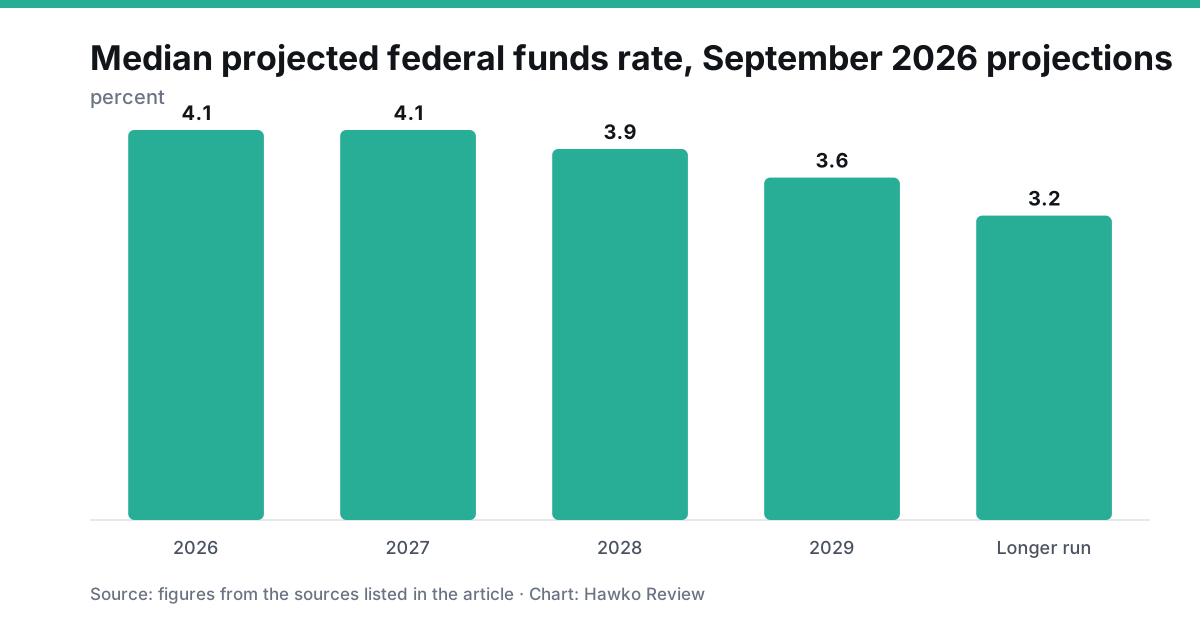
The September 2026 dot plot puts the median federal funds rate at 4.1% for 2026 and 2027, above June's path, as the FOMC raised rates by a quarter point.
The news
The September 2026 dot plot shows FOMC participants lifting their expected path for the federal funds rate across every year of the forecast. The Summary of Economic Projections, released at 2:00 p.m. on September 16 alongside the FOMC statement, puts the median year-end rate at 4.1 percent for both 2026 and 2027, against 3.8 percent and 3.6 percent in June. The Committee voted 12-0 to raise the target range by 1/4 percentage point to 3-3/4 to 4 percent.
Key takeaways:
- Median federal funds rate: 4.1 percent in 2026, 4.1 in 2027, 3.9 in 2028, 3.6 in 2029 and 3.2 over the longer run.
- Median 2026 PCE inflation was raised to 3.7 percent from 3.6 percent; core PCE to 3.4 percent from 3.3 percent.
- Median 2026 unemployment is 4.1 percent, down from 4.3 percent in June, and GDP growth is 2.3 percent, up from 2.2 percent.
- Eighteen participants submitted projections, although one omitted 2028 and 2029.
Our analysis
The table compares September medians with June medians for the main variables.
| Variable | 2026 | 2027 | 2028 | Longer run |
|---|---|---|---|---|
| Real GDP | 2.3 (June 2.2) | 2.4 (2.3) | 2.2 (2.2) | 2.0 (2.0) |
| Unemployment rate | 4.1 (4.3) | 4.1 (4.3) | 4.1 (4.2) | 4.2 (4.2) |
| PCE inflation | 3.7 (3.6) | 2.3 (2.3) | 2.1 (2.0) | 2.0 (2.0) |
| Core PCE inflation | 3.4 (3.3) | 2.5 (2.5) | 2.2 (2.1) | n/a |
| Federal funds rate | 4.1 (3.8) | 4.1 (3.6) | 3.9 (3.4) | 3.2 (3.1) |
The largest revisions are in the policy path and the labor market. The median rate moved up half a point for both 2027 and 2028. The new 2026 median sits above the 3.75 to 4 percent range chosen that afternoon, and the lowest 2026 projection, 3.9 percent, is about the midpoint of the new range. That means at least half of participants see further tightening this year, although the table does not say how many favor each step.
The projections also record a firmer view of the real economy. The 2026 unemployment median falls two-tenths to 4.1 percent and stays there through 2029, and the longer-run median is 4.2 percent. Inflation is expected to take time to recede: 3.7 percent this year, 2.3 percent in 2027 and 2.1 percent in 2028, reaching 2 percent in 2029.
The accompanying FOMC statement gives context. It says economic activity is expanding at a solid pace, that productivity growth is strong and capital investment robust, and that inflation remains elevated. It adds that “the Committee will deliver price stability.”
The longer-run median federal funds rate rose to 3.2 percent from 3.1 percent. That figure is the Committee’s estimate of where policy settles once shocks fade, so even a one-tenth change matters for anyone pricing long-dated bonds.
Room for disagreement
Dots are individual forecasts, not a Committee commitment. The Summary of Economic Projections notes that each participant bases projections on his or her own assessment of appropriate policy. The spread is wide: the 2026 range for the federal funds rate runs from 3.9 to 4.4 percent, and the 2027 range from 3.1 to 4.4 percent. The central tendency for 2027, 3.6 to 4.4 percent, is more than three-quarters of a point wide.
The inflation range tells a similar story. Projections for 2026 PCE inflation run from 2.9 to 3.8 percent, so participants disagree about how much of the year’s price pressure will fade. And a 12-0 vote does not mean a shared view on the next move; unanimity on one decision is compatible with a broad range of paths afterward.
What to watch
- The minutes of the September 15-16 meeting, which the Fed typically publishes three weeks after the decision and which should add detail on the discussion behind the dots.
- Speeches from Committee members in the following weeks, which usually explain the reasoning behind individual dots.
- Inflation reports, especially core PCE, against the median 2026 projection of 3.4 percent.
- Whether the 2027 range narrows or widens in the December projections.
Prepared with AI assistance from public sources and reviewed under our editorial policy. Not investment advice.